
Hate Groups

Hate Groups Are On The Rise: But Why?

Originally Published on the Harbinger


From the very founding of the United States, there has been racism, prejudice and hate present. Even after laws were put into place to avoid discrimination and give every race and gender equal opportunity, there is one thing still evidently present: hate. As of 2018 there have been 1020 hate groups reported and, though the times have changed, different factors have contributed to the increase of hate groups. 

“There is a 30% jump in hate groups that coincides with [Trump] running for office and winning the presidency… Trump plays on fears of  immigrants to build up his base,” said Heidi Beirich, the director of the Intelligence Report, which is published quarterly by the Southern Poverty Law Center. 

Trump has made many allegations towards immigrants, calling them “rapists, criminals,” and so forth. And as a result, many have become fearful of and hateful towards immigrants, believing that they make no contributions the country, and live a life of fear. 

Just as there are people afraid of immigrants, some hate groups and white supremacists are afraid of the increasing diversity occurring in the U.S. These white supremacists believe that, because they are superior, other races shouldn’t be present and that there is no need for diversity.  

“We are now very close, maybe 20 years away from whites being a minority in the United States. And that change freaks some people out, people who are uncomfortable with cultural change and increased diversity and multiculturalism,” said Beirich. 

The response to this fear is an increasing amount of hate towards minorities, the government, and others. Throughout most of the 50 states, there are different clans, from anti-LGBT groups to neo-confederates to the racist skinheads. And since these groups are acting out of hate and anger, violence is often followed. 

“They want to kill minorities, or Jews, or whatever the case may be because they believe that white people should run this country and they’ve decided that the only way to achieve that is through weapons of war,” added Beirich. 

Another factor contributing to the rise of hate groups is social media. With social media platforms such as Facebook and Instagram many of these hate groups now have the means to spread propaganda, recruit members, and organize rallies. Unlike people decades ago, users now have the ability to see all that hate groups have to say with as little as a click or a scroll. 

In Florida, there have been 75 active hate groups reported, the third highest in the United States. Not only is Florida home to a great amount of people—over twenty million—there is also divisiveness in the state, which is especially seen during the election.  

“States like California, Florida, and New York that have large populations are often at the top of the list for hate groups… California and New York, when you look at the number of hate groups per capita is actually much lower than Florida… That reflects partly that Florida, although the southern part of the state is very cosmopolitan and very multicultural, the panhandle and the northern area are more like their cousins in the deep south,” said Beirich.  

Seeing as how many social media platforms that are trying to perfect algorithms which will prevent hate groups from continuing to gain momentum and diversity in the U.S. are also increasing, it is projected that the amount of active hate groups will also continue to rise. The hate that resided in America before the 1960s is still here today, and for the time being, will continue to be evident in clans throughout the country.


Photo taken by AFP

Bonds & Memories

It’s funny how you can spend four years seeing someone everyday at school and utter two words to them, but tell your life story to someone you’ve just met. There’s something about rooming or being with someone for a short period of time and knowing that you’ll probably never see them again that inclines people to share stories and form a bond. This is currently the case for me, seeing as this is my last day at the FBLA 2019 State Leadership Conference.

At the meeting we had before going to Orlando, my club adviser told us, “you’re rooming with different people, but it’s only awkward for like 30 minutes.” When I entered the hotel  room I’m staying in along with three other girls, there was no awkwardness. We immediately hit it off, discussed our routines, and even almost forgot to introduce ourselves. Not too long after that we, along with some of the boys from my school, and my roommate’s school, went mini golfing. Suddenly, I was outside with ten other people, playing a game I have never played before, and laughing at jokes. It was as if I knew these individuals for half my lives and we were a group of friends just hanging out.

Yesterday after our meeting and workshops, my roommates (Chelsea, Amanda, Elizabeth) and I sat in our room, and started talking just about everything, from school to relationships. Amanda got up from the bed she was laying on, and came to my bed to show us a picture of someone she’s close to and Elizabeth moved from her chair to the bed as well. There we were, four girls who barely knew each other prior to the trip, on one bed, telling stories about our personal lives, asking questions, and getting slightly frustrated at the actions boys do that make absolutely no sense to us. Our conversation was so long that when one of us looked at the time, we had twenty minutes to get ready for dinner.

This trip has been an amazing experience, and I love how I not only became closer to the two people I did know here (Kevin and Chelsea), but also spent time with a great group of people. I don’t know if I’ll keep in touch with the people I’ve met here. I don’t know if when I get back to school, Kevin, Chelsea and I will go back to occasionally conversing. But what I do know is that I will treasure the memories I made over these three days and they will forever be embedded in my mind.


Issues

Issues — We all have them. Every human being is different, and none of us come without flaws. Somewhere out there is someone who has a pet peeve that you do everyday. And somewhere out there is an individual who does that lying without reason thing, or whatever it is, that you dislike. Just as each and every person on this planet has their share of flaws, they have their set of issues. Our issues are the things we’re constantly battling with, or at least ignoring until we can’t anymore. Whether or not we acknowledge them, they are there, influencing our decisions or lack thereof. Our issues are the things possibly hold us back from being all that we want to be, limiting us from being one of the greatest the world has ever seen. Our issues, which to someone else, makes absolutely no sense, but to the person with the issues, are like annoying flies that keeps buzzing near one’s ear. Basically, our issues hold us down, effect us daily, and can be annoying.

Everyone’s issue is different. For someone, is not being able to let go, especially of the relationship you’re sure you put your heart and soul into. For another, it’s fluctuating insecurities, preventing them from mastering the ‘art’ of self love. Everyone has their issues, their flaws, and things they need to work on. That’s how it is. The first step, I would think, is to acknowledge that. Acknowledge that you are not alone, that the person to the right of you, and the person to the left, are also dealing with their personal issues. That’s a good place to start.

After the acknowledging that everyone has the things their struggling with, one should address what their issue is. Which, believe me, can be difficult. No one wants to tell themselves “yeah, I have commitment issues and am the reason why none of my relationships can truly go anywhere.” It’s legitimately difficult. 

And following with all of the acknowledging is figuring out where these issues stem from, thinking about and realizing what exactly brought you here. Which will no doubt bring memories you don’t want to think about, and half the things you were running from will come into light. There is a reason you were running from them, after all. But I think that this is a necessary step, it is all part of the process.

So,  say one has acknowledged that everyone has issues, acknowledged their issues, and dove deep into their conscious to figure out where they came from, there still an important step left: do something about it. If you don’t take action after all the soul searching, then what was really the point, to say,  “I have commitment issues, and none of my relationships will never work out?” The statement would vary based on the situation, of course. Not only is taking action a vital step, it just might be the hardest. Because (using the commitment issues example again) suddenly learning how to trust is no walk in the park.

Actually working on the issues takes time and dedication. One day, one tiresome, difficult day, you’re probably going to ask yourself, “do I even need to do this?” In the event that happens though, the answer is yes. You do. You owe it to yourself. How you would do this though, would vary on the person. Speaking from personal experience, having friends as my support group and motivators works fine.

With the working with these issues and problems at hand will come growth, and more self love, and that is such a beautiful thing. Five years down the line, the person who has now overcome their commitment issues will be gazing into their spouse’s eyes, thinking, “wow, if this was five years ago, there’s no way I’d be here right now.” Sounds pretty amazing to me.

Another thing to understand is that even after you have worked on your issues, there will still remain a quirk, or maybe a bad habit that’ll never go away. You’ll still have your “imperfections” in your physical features and your personality. Nonetheless, never give up the chance to live, learn, and grow.

Perfection’s overrated anyway.

Strength

You are stronger than you know.

You are strong, and it shows.

Sometimes it is easier to see our weaknesses, what we lack, what we should have

And harder to embrace ourselves, who we are, and our strength.

You are stronger than you know.

You get through each day.

You endure the heartaches, the headaches, and the heartbreaks.

You are strong, and it shows.

Sometimes you may feel like your world is crumbling down,

And that better days are nowhere to be found.

But Alas, here you are, facing the difficulties, and getting up day after day.

You are strong, even though you may think otherwise.

You are strong, even if what you feel says otherwise.

You are strong,

And it shows.

Pride & Anger

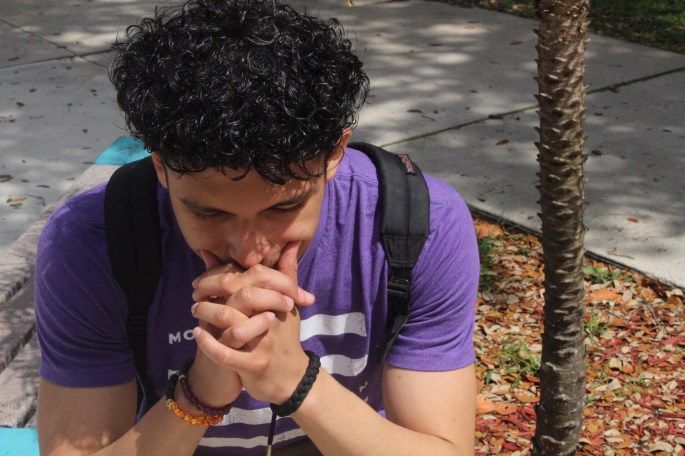
When I interviewed Norlan Gutierrez, a junior at MLEC, I asked him if there was anything that he’s passionate about. His answer was God. Norlan begins by saying that God, Yahweh, is merciful, shows him grace, and gives him hope. He then explains two things that he struggles with, pride and anger, and relates it back to his relationship with God.

“Pride and anger are two things I struggle with daily, I’m known for my pride and my anger. People usually have pride because they expect things for them, and I know that I shouldn’t be expecting anything from anyone. Nobody owes me. If someone were to come into my space and doesn’t say anything to me, the next time I won’t say anything to them. I don’t know, maybe it is just the way I was raised. And anger… When I react in anger, I do things that I regret, and by the time I realize it, it’s too late. If someone says to “shut up,” I know I can either ignore it or react, but I’m usually quick to defend myself. I’m not quick to understand that this person might be having a bad day. Sometimes I come off as aggressive, but I don’t mean anything by it. That’s just my personality. I wish I could say, “Everything I say, don’t take it personally, please don’t,” to everyone I meet. I try my hardest to work on them, but it is easier said than done. I know by not being prideful and angry, that makes me vulnerable to God, and that would help our relationship. And I want that because God, Yahweh, is my everything, my number one.”

– Norlan Gutierrez, Junior, Health/EMR