
Microwave Generation

Microwave Generation

By Rhobie Toussaint

If one were to compare all of the major social media platforms that have appeared throughout the years, from MySpace to Facebook to Snapchat, a similar trend would be seen– modern means faster.

Coined by Raymond James, the term “Microwave Generation” sums up the impatience of Generation Z, those born between the years of 1995 and 2015. 

As people consume more information through the internet and different social media platforms, they also start to expect technological updates at a faster speed.

 For example, 4G, the fourth generation of cellular technology has an average speed of about 10 megabits per second (Mbps), but 5G, which is not fully researched or developed, is already being advertised by telecommunications companies. 

5G proposes some health concerns due to radiofrequency radiation and security violations. However, to most people the benefits seem to outweigh these dangers – with higher download rates, internet with even higher speed, and more, the microwave generation is bound to make some sacrifices for 5G.

The high expectations and need for constant renovation seen in Gen Z is ultimately what drives their impatience. Anything less than the speed and consumption of information that they are used to can lead to instant dissatisfaction.

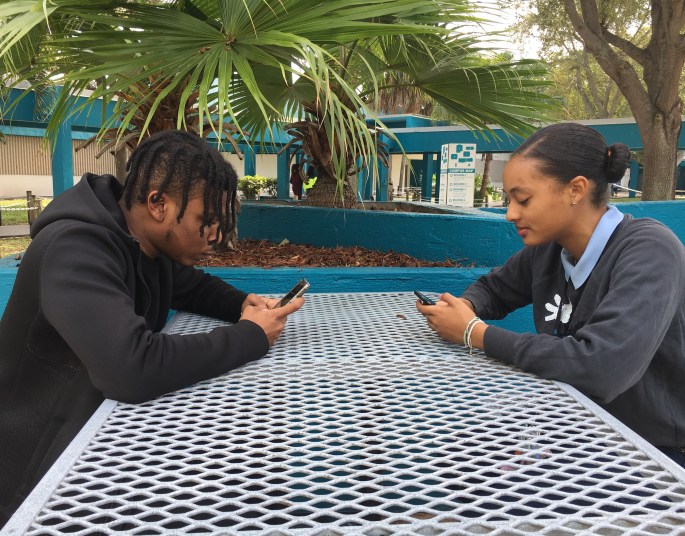
“Most of the people our age can barely remember a time before the internet was as big as it is now, and in some ways, our generation does want that information more,” said Andrew Easterling, a junior at MLEC.

But this is not Gen Z’s fault. Nothing more and nothing less can be expected from a group of people that grew up during a time period of the latest smartphones and fastest internet speeds. If millenials or any other generation grew up with the same circumstances that Gen Z has, it is more than likely that they’d share similar traits.

“My parents are Gen X, and I’ve seen them, people even older, and everyone in between uses the internet for information, ” said Andrew.

Moreover, the expectations of more information in little time goes beyond those of Generation Z. It is a societal trend. Many who can have these technological advances are prone to expecting more– more technological advances, more information, more access. 

“From my understanding, most people actually want constant updates and upgrades, but that’s just because of the times we are living in,” said Adrien Rivero, a senior at MLEC. 

We have come to a point where it is only natural that people, of different age groups and ranges, are searching and yearning for quick renovation.

“I think people in general are always looking for change and improvement in whatever it is that they do,” added Rivero. 

This isn’t just a microwave generation. It is a microwave society. 

Puerto Rico

Earthquakes In Puerto Rico

By Rhobie Toussaint

Since Hurricane Maria in 2017, parts of  Puerto Rico are still in a state of devastation. The death toll reached just over 2,000 people; the agricultural yield has a loss of about 780 million dollars, and there are people still emigrating from Puerto Rico to the U.S. due to the state of the island. 

Now, another kind of natural disaster has hit the struggling island— earthquakes.

The earthquakes in Puerto Rico have left homes leveled, caused the displacement of  residents with nowhere to go, and lead to one known death. The island has been experiencing consecutive earthquakes, and Puerto Ricans have been experiencing their effects since December. 

“Personally, it’s been devastating seeing the people of Puerto Rico struggling with the many disasters that have been happening lately. Knowing they just suffered from a horrible hurricane that destroyed their homes and communities, many people probably don’t have the strength to go back to shelter,” said Jean Laguerre, the President of MLEC’s Caribbean Culture Club. 

These earthquakes have had magnitudes as high as 6.4, which was the magnitude of an earthquake in January that took place in Puerto Rico. Records show that these earthquakes resulted in about 5,000 Puerto Ricans to be unable or unwilling to return to their homes, meaning that many are without shelter. 

What’s happening in Puerto Rico is extremely unfortunate. They were just starting to recuperate after hurricane Maria when the first earthquake hit. My family home on the island is in shambles and there’s nowhere for my relatives to go,” said Krystal Alverio, a Puerto Rican student at MLEC. 

Places such as the Poinciana Condominium in Puerto Rico, which includes medical, commercial, and residential floors, have become officially uninhabitable because of the structural damage. 

As a result of this, the Puerto Rico’s governor, Wanda Vasquez declared a state of emergency. 

The residents in  Puerto Rico are in desperate need of aid to restore their homes, and access other resources and necessities. But the country is not receiving all of the help it needs.  

Recently, there has been a video of a warehouse full of unused supplies which, according to Vasquez, has been there since Hurricane Maria. The video went viral, causing residents to take matters into their own hands by breaking into the warehouse and distributing the supplies themselves. 

The governor fired the commissioner of the National Emergency Management and Disaster Relief Agency, who claims he has not deprived anyone of accessing the supplies in the warehouse.

   After the earthquakes in January, Wanda Vasquez requested aid from the U.S., as Puerto Rico is a U.S. territory. The Trump administration, however, has imposed multiple conditions on Puerto Rico, and these conditions must be met before the island can access 8.3 billion dollars.

“After Hurricane Maria, congress has since approved $44 billion for recovery from the federal department housing and health. However, the people from the Island have had access to only $2 billion up to this month,” said Jean Laguerre.

 The officer of management, Chase Jennings, says this is to hold Puerto Rico accountable while helping them.  

Some parts of Puerto Rico have recovered, especially areas where tourists visit and stay. But for the most part, there are still people living on the streets who are begging for help, homes that haven’t been restored, and people yet to receive aid. 

“I visited the more touristy parts of Puerto Rico and while I was there I saw two people one had a sign that said something along the lines of, “I lost my home to hurricane Maria, I need a place to stay. It was sad to see because there was someone begging for a home next to booths that  tourists are visiting,” said Samantha Jimenez, a student at MLEC.

“It’s sad to see that years later, they have never really recovered and that the island has turned to covering that up to pretend that nothing is going on and people can visit,” added Jimenez.